-
November 11, 2026
Some engines are remembered for their power. And some engines changed the history of a sport.
The Ford Cosworth DFV is one of them. For the 2026 São Paulo Grand Prix, we at Trideo were presented with a challenge that was as exciting as it was demanding: to use 3D printing to create a replica of this legendary Formula 1 V8 engine, to be integrated into a vintage race car equipped with a simulator.
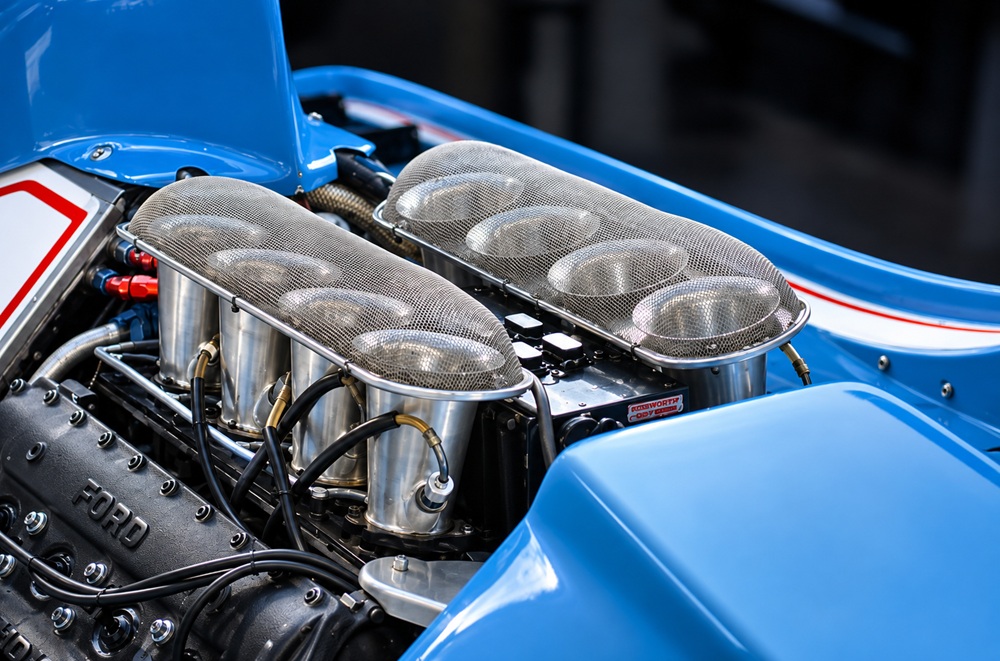
Here's a behind-the-scenes look at the project: from the digital model to the finished piece, via our BIG T large-format printers.
The DFV (Double Four Valve) is a 3.0-liter V8 engine designed by Keith Duckworth and Mike Costin with funding from Ford. It made its debut at the 1967 Dutch Grand Prix in Zandvoort and won its first race with Jim Clark behind the wheel of the Lotus 49.
From that point on, it became the benchmark engine in the category: by 1983, it had already racked up 155 Formula 1 victories, a record number for its time. Furthermore, it was one of the first engines to be integrated into the car’s structure, an idea that influenced the design of Formula 1 cars for decades.

Replicating an engine like this isn't just a matter of size—it's an object full of details that any motorsports fan would recognize. The replica had to live up to the original.
The replica was part of the experience set up at Vila Porto, Porto Bank’s venue during the 2026 São Paulo Grand Prix. There, the engine was integrated into a vintage Formula 1 car equipped with a simulator, designed to let the public experience the thrill of the racetrack up close.

That entailed several requirements at the same time:
It all started with digital printing. Thanks to the capacity of our printers, a 1.20-meter-long motor could be divided into just about ten parts. Each part was positioned and prepared to achieve the best surface quality, minimize support structures, and facilitate subsequent assembly.
The parts were printed on two of our BIG T printers working in parallel—the 3D printer with the largest print volume in Latin America: 1 m³ (1000 × 1000 × 1000 mm). This volume allows us to manufacture large components, such as the engine block, in very few parts. Fewer sections mean fewer joints, greater rigidity, and a cleaner finish.

Result: 25 kg of PLA printed in one week. Working with two large-format machines at the same time is what allows us to meet event deadlines without compromising on part size.
For display replicas, PLA is a very efficient choice: it offers good dimensional stability in large parts, minimal tendency to warp during printing, and an excellent surface finish, making it ideal for post-processing and painting. If you'd like to compare options, check out our guide to 3D printing materials.
To understand why this type of machine is a game-changer, we recommend our article on large-volume 3D printing.
After coming out of the printer, each component went through our process: removing supports, cleaning, and surface preparation. It’s a manual and meticulous step, but it’s key to making the replica look like a finished object rather than a freshly printed part.

Finally, the team adjusted and assembled each part until the engine—including the block, cylinder heads, transmission, and exhaust system—was complete and ready to be installed in the car.
A one-of-a-kind replica, with complex geometries and a tight deadline, is exactly the kind of project where 3D printing outperforms traditional processes:
It's the same approach we've taken with other large-scale projects, such as the 3-meter-tall giant Bruce Lee or the 11-meter-tall architectural wall printed for a corporate space in São Paulo.
This project showcases an increasingly common use of 3D printing: large-scale replicas for events, brand activations, and immersive experiences. Engines, vehicles, products, characters, or historical artifacts can be reproduced at actual or enlarged scale, with a level of detail that captures the public’s attention and generates content for social media.

If you work at an agency, a brand, or an event production company, 3D printing allows you to turn an idea into a physical object within a timeframe that fits a campaign’s schedule.
At Trideo, we support every project from design through final assembly, using our own large-format 3D printers in São Paulo, Buenos Aires, and Mexico City.
Tell us about your idea: upload your file to our online 3D printing quote tool or contact us, and let's bring it to life together.

Upload your .stl or .obj model and get a quote in minutes. No obligation.

Industrial 3D printing service and professional printers in Argentina, Brazil and Mexico.